Hey there, fellow med tech folks and healthcare providers! If you’ve ever sat in on an endoscopy procedure, you know how critical that tiny camera at the end of the scope is. It’s not just a “viewing tool” — it’s the difference between catching a tiny polyp before it becomes something bigger, avoiding a misdiagnosis, or even cutting down procedure time. As someone who’s been in the medical endoscope camera supply game for years, I’ve seen first-hand how so many small factors add up to game-changing performance (or frustrating, costly errors). Let’s break down what actually affects that camera’s ability to do its job right, no jargon, no fluff — just what you need to know to pick the right gear for your practice. Medical Endoscope Camera

First up, sensor quality. Let’s be real, the sensor is the camera’s brain, right? It’s the part that turns light bouncing off the tissue into the images you see on the screen. But not all sensors are created equal. A lot of cheaper endoscope cameras cut corners here, using basic CMOS sensors made for consumer webcams instead of ones calibrated for medical use. Consumer sensors mess up low light or close-up shots, which are non-negotiable in endoscopy — think about the tight, dark spaces inside a patient’s GI tract or bronchial tubes. Medical sensors have better dynamic range, meaning they can pick up details in both super bright areas (like the top of the esophagus) and dim, shadowed crevices without blowing out the screen or making everything black. I can’t tell you how many times a clinic has come to me complaining their old camera missed a small lesion because the sensor couldn’t handle the low light. Another thing: resolution isn’t just about megapixels. A 10MP consumer sensor might look sharp on your phone, but a medical sensor needs consistent color accuracy too. If the camera can’t tell the difference between a red polyp and the surrounding tissue because the color calibration is off, that’s a huge risk. We’ve tested our cameras with industrial-grade medical sensors that hit 4K resolution with color accuracy within the medical standard, and it makes a world of difference during biopsies.
Next, lens design and durability. The lens is what sits right at the tip of the endoscope, and it’s exposed to all kinds of stuff — bodily fluids, sterilization chemicals, even tiny scrapes against tissue. A lot of people overlook this part, but a bad lens can ruin a great sensor. First, anti-reflective coating. In endoscopy, you’re dealing with a lot of light bouncing back — if the lens has a cheap coating, you get glare that obscures the view. I’ve seen procedures where the tech was wiping the lens every 30 seconds because of glare, which not only slows things down but also breaks the sterile field. Our cameras use multi-layer anti-reflective coatings that cut that glare way down, so techs only need to wipe the tip once or twice at most. Then there’s the lens material. Many cheap lenses are made of regular glass that can scratch easily, or plastic that gets foggy after a few sterilization cycles. Medical endoscopes go through autoclaving, chemical sterilization, and even high-temperature washes — the lens needs to hold up to that. We use sapphire-coated lenses on all our cameras, which are scratch-resistant and stay clear through hundreds of sterilizations. I remember a clinic that was replacing their old camera lenses every 3 months because they’d get scratched, and switching to ours cut that replacement time to over a year. That’s not just convenience — that’s saving them thousands in supply costs annually.
Light source integration. Wait, hold on — the camera doesn’t work alone here. The light source paired with it is just as important, because if the light is dim or uneven, the camera can’t capture a good image. A lot of suppliers sell cameras and light sources separately, but that’s a mistake. The two have to be matched. For example, a high-res camera needs a light source that’s bright enough at the right wavelength — endoscopy light needs to mimic natural tissue light, so it can show real color. If the light is too blue, polyps might look the same as normal tissue; too red, and you miss small abnormalities. Also, light uniformity. If the light is brighter in the center of the view and dimmer around the edges, that makes it hard to examine the outer parts of the procedure area. Some cheap light sources use basic LEDs that drift in brightness over time, so after a few uses, the image gets darker. We design our cameras to work with our proprietary light modules that maintain consistent brightness and wavelength, plus they auto-adjust to the procedure area — if you move the scope closer, the light dims automatically so you don’t get glare, and when you move it back, it brightens up. That auto-adjust feature is a game-changer for new techs too, who don’t have to fiddle with light dials mid-procedure.
Cable integrity and signal transmission. The cable that connects the camera tip to the control unit is the lifeline for the image — if the signal gets degraded, you get lag, pixelation, or even frozen screens mid-procedure. A lot of medical facilities use generic cables that aren’t made for heavy use. They get twisted, pulled, stepped on, and bent hundreds of times, which damages the internal wiring over time. When the wiring is frayed, the digital signal gets noisy, so the image has static or breaks up. I’ve had a surgeon tell me a procedure almost had to be stopped because the camera cable was glitching — they had to hold the cable a certain way to get a clear view, which added 10 minutes to the case and put unnecessary stress on the patient. Our cables are reinforced with braided stainless steel to handle bending and pulling, and we use shielded wiring that blocks electromagnetic interference from other medical devices in the OR. That means no static, no glitches, even when you’re working near monitors or other equipment. Also, cable length matters — too short, and you’re limited in movement; too long, and the signal has to travel further, which can cause lag. We offer customizable cable lengths, so clinics can pick the right one for their OR setup without sacrificing signal quality.
Temperature management. This is a weird one, but it’s huge for performance. Medical endoscope cameras get hot, especially if they’re used for long procedures or in rooms with no climate control. If the sensor gets too hot, it can overheat, leading to image distortion, color shifts, or even the camera shutting down mid-use. I once heard about a clinic that had a camera die during a colonoscopy, and they had to switch to a backup scope, which delayed the procedure and made the patient uncomfortable. Our cameras have built-in thermal sensors that monitor temperature in real time, and they have passive cooling vents that don’t take up extra space (since endoscopes need to stay slim enough to fit into small body cavities). The thermal system keeps the camera at a consistent temperature even after 2 hours of continuous use, so no overheating, no interruptions. We’ve tested this in clinical settings — in rooms that hit 90 degrees F, our cameras stayed within the safe operating range, while competitors’ cameras started to distort after 45 minutes. That reliability is non-negotiable when you’re in the middle of a critical procedure.
Sterilization compatibility. Okay, this isn’t just about durability — it’s about performance too. If a camera’s housing is damaged by sterilization chemicals, it can leach materials into the body, but also, the lens or sensor can get foggy or discolored after multiple cycles, which ruins image quality. Some cheap cameras use plastic housings that get cloudy after a few autoclave runs, so you can’t see details anymore. We design our camera housings from medical-grade polycarbonate that’s resistant to all standard sterilization methods — autoclaving, glutaraldehyde, hydrogen peroxide plasma, you name it. We also test each camera to make sure that after 1,000 sterilization cycles, the image quality is still within medical standards. That’s important because if you have to throw away a camera after only 100 uses, you’re wasting money, but also, a foggy camera means you’re not getting accurate views. I’ve had a pediatric gastro clinic tell me they switched to our cameras because their old ones got cloudy and made it hard to examine a kid’s narrow esophagus — now they can see every small detail, and they’ve had zero issues with sterilization-related performance drops.
Wait, let’s talk about user settings too. A lot of people forget that even the best camera won’t perform if the user doesn’t know how to adjust the settings. But that’s also a part of the camera’s design — how easy it is to tweak settings like brightness, contrast, and color saturation. Some cheap cameras have clunky controls that require going through multiple menus mid-procedure, which is frustrating. Our cameras have one-touch controls right on the scope handle, so you can adjust brightness or color in 1 second without taking your hands off the scope. We also include pre-set profiles for different procedures — like GI endoscopy, bronchoscopy, or orthopedic arthroscopic surgery — so techs don’t have to mess with settings from scratch. That consistency means every procedure gets the best possible image, no matter who’s operating the camera.
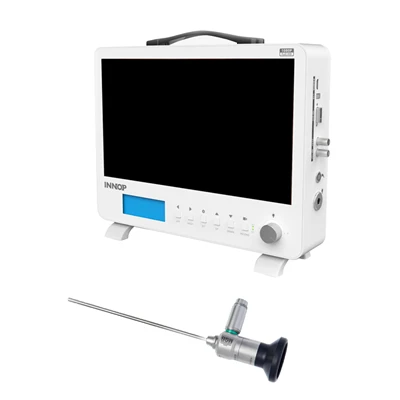
Now, let’s wrap this up. All these factors add up to the camera’s performance — it’s not just one thing, it’s the sensor, lens, light, cable, temperature, sterilization, and user design. As a medical endoscope camera supplier, I don’t just sell you a device — I build ones that work for the real, messy, fast-paced world of medical procedures. If you’re tired of cameras that glitch, overheat, or give blurry images mid-case, we can help you find the right setup for your practice. Whether you’re a small clinic with 10 endoscopy rooms or a large hospital with 50+ cases a day, we’ve got options that fit your needs and budget. If you want to chat more about what factors matter most for your specific procedures, feel free to reach out to our team to start a procurement conversation — we’re here to make sure you have the gear that lets you focus on what matters most: patient care.
Endoscope Monitor References
- Medical Device and Diagnostic Industry (MD+DI) – Endoscopic Camera Performance Standards, 2022
- Journal of Biomedical Materials Research – Lens Durability in Sterilization Cycles for Endoscopes, 2021
- Clinical Gastroenterology and Hepatology – Impact of Image Quality on Endoscopic Lesion Detection, 2020
- International Organization for Standardization (ISO) – Medical Endoscope Camera System Requirements, ISO 10993-5, 2019
- Journal of Medical Engineering & Technology – Signal Transmission in Flexible Endoscope Cables, 2023
Shenzhen INNOP Medical Instruments Co., Ltd.
With abundant experience, we are one of the leading manufacturers and suppliers of medical endoscope camera in China. Please feel free to buy advanced medical endoscope camera in stock here from our factory. We also accept customized orders.
Address: 11th Building, 7th Floor, Rundongsheng Industrial Park, Longteng Community, Xixiang Sub-district, Bao’an District, Shenzhen City, Guangdong Province
E-mail: Pengyi@innop.cn
WebSite: https://www.innopmedical.com/
